

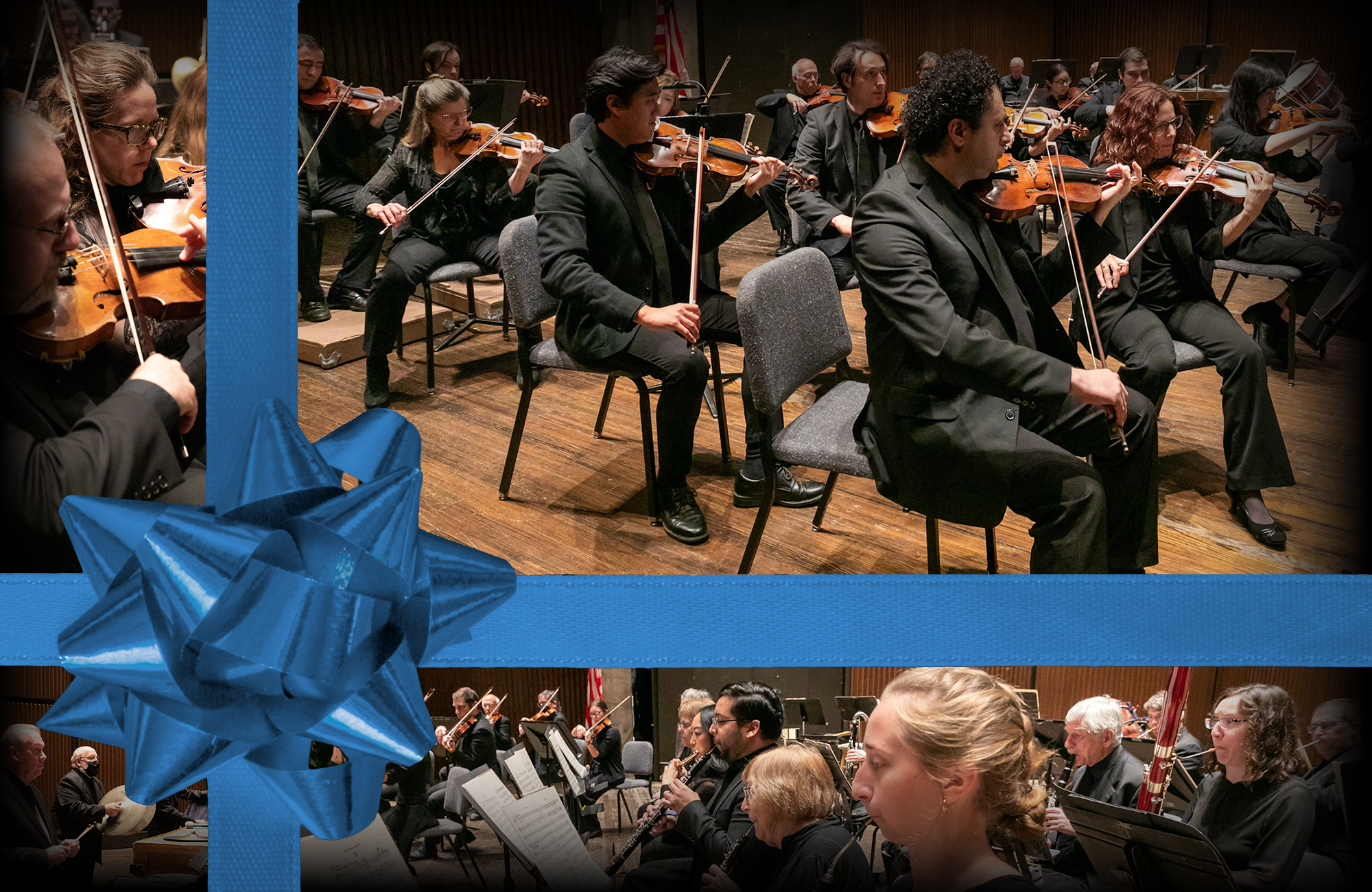
The Syracuse Orchestra performs at the historic Smith Opera House in Geneva, NY performing a selection of holiday classics that is sure brighten the season!
Tickets available at www.GenevaConcerts.org and at the door
$35 Adult/Senior | $10 College Student with ID | FREE Child through Grade 12 | FREE HWS Students
Also available at Stomping Grounds in Geneva (cash or check only)
PROGRAM
COLERIDGE-TAYLOR: Christmas Overture
HOVANNESS: Symphony No. 49 “Christmas”
PROKOFIEV: Lieutenant Kijé, op.60: Troika
VAUGHAN WILLIAMS: Fantasia on Greensleeves
TCHAIKOVSKY: The Seasons: Christmas (December)
HEINEKE: Ukrainian Bell Carol
TCHAIKOVSKY: Nutcracker (Selections)
– Mother Ginger
– Chinese
– Russian
– Waltz of the Flowers
Thanks to the 2025-26 Sponsors!


This series of programs is made possible, in part, with funds from the Williams Family Foundation; the Wyckoff Family Foundation; Hobart and William Smith Colleges; Rotary Club of Geneva; and The New York State Council on the Arts with the support of the Office of the Governor and the New York State Legislature.
PROGRAM NOTES
At first glance, this concert’s selections may seem like a mosaic of holiday favorites drawn from different eras, countries, and musical traditions. But taken together, they trace a surprisingly interconnected story about how composers have used Christmas—its imagery, myths, and spirit—as a lens through which to explore national identity, folklore, and even political history.
We open with Samuel Coleridge-Taylor’s Christmas Overture, drawn from incidental music he wrote in 1909 for the play The Forest of Wild Thyme. Coleridge-Taylor—celebrated in his day as the “African Mahler”—built the overture around familiar carols like “Good ...
At first glance, this concert’s selections may seem like a mosaic of holiday favorites drawn from different eras, countries, and musical traditions. But taken together, they trace a surprisingly interconnected story about how composers have used Christmas—its imagery, myths, and spirit—as a lens through which to explore national identity, folklore, and even political history.
We open with Samuel Coleridge-Taylor’s Christmas Overture, drawn from incidental music he wrote in 1909 for the play The Forest of Wild Thyme. Coleridge-Taylor—celebrated in his day as the “African Mahler”—built the overture around familiar carols like “Good King Wenceslas,” repurposing them for the concert stage. His interest in cultural identity and folk material places him in a lineage shared with Vaughan Williams and even Prokofiev, who similarly reimagined traditional tunes through modern orchestration.
The international thread continues with Alan Hovhaness’s Symphony No. 49 “Christmas.” Written in 1978 for the Seattle Symphony, it reflects Hovhaness’s blend of Armenian heritage, early music, and non-Western sacred traditions. Instead of festive holiday scenes, he offers a meditative, mystical atmosphere—closer to ancient ritual than celebration, and subtly aligned with the contemplative quality found later in Vaughan Williams’s Greensleeves fantasia.
From this spiritual quiet, we shift to the brisk winter imagery of Prokofiev’s “Troika” from Lieutenant Kijé. Though now a Christmas staple, its holiday identity wasn’t intentional. The film has nothing to do with the season; the association grew from its sleigh-bell rhythms and its mid-20th-century adoption in Christmas recordings. That cheerful surface masks the score’s original satirical edge, aimed at Soviet bureaucracy—another reminder of how context can transform a piece’s cultural meaning.
Vaughan Williams’s Fantasia on Greensleeves provides a contrasting form of musical reinvention. The melody, likely from the late 1500s and long (incorrectly) attributed to Henry VIII, was adapted by the composer for his opera Sir John in Love. Its link to Christmas arises through the carol “What Child Is This?” illustrating how a tune can shift between secular, historical, and sacred worlds across centuries.
In Tchaikovsky’s “December: Christmas” from The Seasons, we see holiday imagery shaped by 19th-century Russian salon culture. Commissioned for a monthly magazine, The Seasons began as a practical assignment rather than a deeply personal project, yet “December” hints at the wintry charm and dance impulses that Tchaikovsky later expanded in The Nutcracker.
The evolving nature of holiday music continues with Kurt Heineke’s arrangement of the Ukrainian Bell Carol. The tune, originally Shchedryk, was composed in 1916 by Mykola Leontovych and based on an ancient New Year’s chant predicting a bountiful spring. Only after English lyrics transformed it into “Carol of the Bells” did it become intertwined with Christmas—a path similar to the transformations seen in Greensleeves and Troika.
The program culminates with selections from Tchaikovsky’s Nutcracker, now inseparable from the season despite its mixed reception in 1892. Its rise to Christmas prominence came mostly through Tchaikovsky’s Suite, which captured audiences long before full productions became seasonal traditions in the United States. Tonight’s excerpts—Mother Ginger, the Chinese and Russian dances, and the Waltz of the Flowers—show how Tchaikovsky blended global imagery, fantasy, and festive color into the most enduring holiday ballet of all.
FEATURED ARTISTS
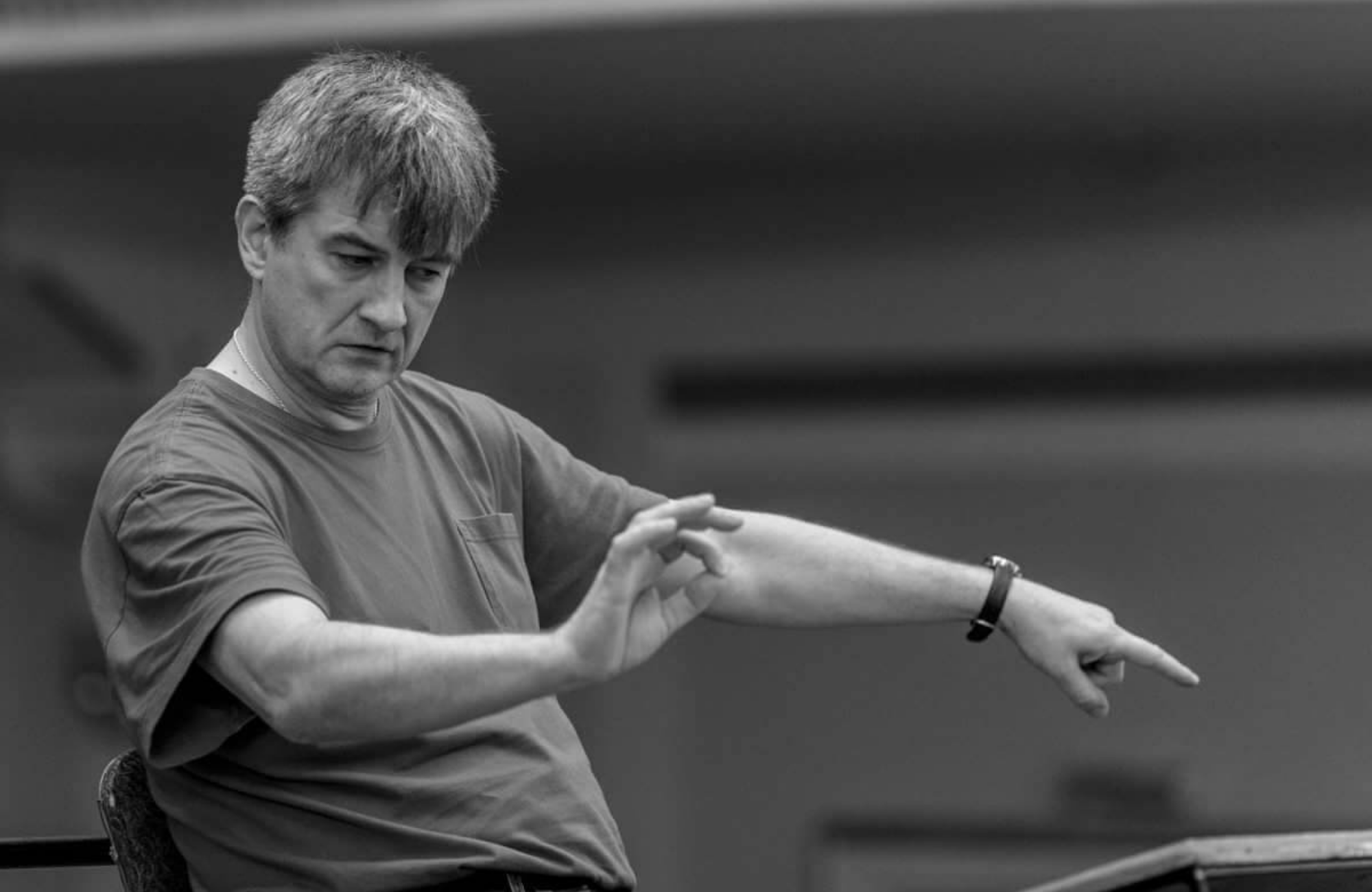
The Ukrainian-born, American-based conductor Taras Krysa is establishing a reputation for innovative and inspiring music-making and leadership throughout the United States and Europe. Recently appointed as the Music Director and Conductor of Lviv Philharmonic Orchestra – the oldest professional orchestra in the Ukraine – Mr. Krysa continues to serve as the ...
The Ukrainian-born, American-based conductor Taras Krysa is establishing a reputation for innovative and inspiring music-making and leadership throughout the United States and Europe. Recently appointed as the Music Director and Conductor of Lviv Philharmonic Orchestra – the oldest professional orchestra in the Ukraine – Mr. Krysa continues to serve as the Director of Orchestras at University of Nevada, Las Vegas.
Taras Krysa guest conducted orchestras including the National Symphony Orchestra of Ukraine, New World Symphony, Netherlands Symphony Orchestra, St. Petersburg Symphony, Moscow Soloists, Slovak Sinfonietta, Spoleto Festival USA Chamber Orchestra, Kiev Chamber Orchestra, the Lublin Philharmonic Orchestra, Las Vegas Philharmonic and many others. In addition, Mr. Krysa led the National Symphony Orchestra of Ukraine, Lviv Philharmonic Orchestra and the Slovak Sinfonietta Chamber Orchestra on several European and Asian tours.
Mr. Krysa recently concluded his ninth season as the Artistic and Music Director of the Henderson Symphony Orchestra in Nevada. Under his leadership, the ensemble has seen its audience expand ten-fold and its concerts recognized as a treasured part of the cultural life of the greater Las Vegas community.
Mr. Krysa actively promotes new music and has made three critically acclaimed recordings for the Brilliant Classics label.
An accomplished violinist, Taras Krysa was a member of the St. Louis Symphony Orchestra and the New World Symphony Orchestra, and continues to maintain an active career performing chamber music.
Taras Krysa was born in Kiev into a dynasty of professional musicians. His father, Oleh Krysa, is a prominent concert violinist. His mother, Tatiana Tchekina, was as concert pianist, and his grandfather, Pavel Tchekin, was a tenor at the Bolshoi Theatre in Moscow.
Mr. Krysa attended the Gnesin School of Music in Moscow before emigrating with his family to the United States 1989 where he continued his studies in conducting and violin at Indiana University and Northwestern University with Victor Yampolsky and Nelli Shkolnikova. Mr. Krysa was recipient of fellowship the American Academy of Conducting at Aspen Music Festival, where he studied with Jorma Panula and David Zinman.