
This concert features three composers who crossed and blurred the boundaries of jazz, Broadway, and classical music.
Performances of this concert are on Saturday, January 10 at 7:00 PM and Sunday, January 11 at 3:00 PM.
PROGRAM
JOHNSON: Victory Stride
GERSHWIN: Embraceable You (Bennett Version)
GERSHWIN: Someone to Watch Over Me
GERSHWIN: The Man I Love
GERSHWIN: Fascinating Rhythm
WEILL: Symphony No. 2
Thank you to our generous sponsors!
Thank you to our Series sponsors!
Casual Series Sponsor:

Exclusive Auto Sponsor:

Thank you to our concert sponsor!

PROGRAM NOTES
The three composers we’re featuring today-James P. Johnson (1894-1955), George Gershwin (1898-1937), and Kurt Weill (1900-1950)-have a lot in common. Born at about the same time and showing precocious youthful talent, they all went on to write songs that stand among the twentieth century’s most memorable, including “The Charleston” (Johnson), “Mack the Knife” (Weill), and the four Gershwin songs that Katie Weber will be performing. All three wrote politically inflected works, including some that touched on the racial politics of the day. Their artistic lives intersected in numerous ways, ...
The three composers we’re featuring today-James P. Johnson (1894-1955), George Gershwin (1898-1937), and Kurt Weill (1900-1950)-have a lot in common. Born at about the same time and showing precocious youthful talent, they all went on to write songs that stand among the twentieth century’s most memorable, including “The Charleston” (Johnson), “Mack the Knife” (Weill), and the four Gershwin songs that Katie Weber will be performing. All three wrote politically inflected works, including some that touched on the racial politics of the day. Their artistic lives intersected in numerous ways, too: Johnson and Gershwin knew and admired each other, probably having first met when they were working as song pluggers on Tin Pan Alley; both Gershwin and Weill wrote several works with lyrics by Gershwin’s brilliant wordsmith brother Ira; Weill and Johnson both collaborated with Langston Hughes.
More significant is a curious fact: Johnson, Gershwin, and Weill are opera composers-but they all had their music championed by such jazz superstars as Ella Fitzgerald and Louis Armstrong. That’s not just fuel for a trivia contest. Rather, that apparent incongruity reveals a lot about their aesthetic principles. These composers refused to be limited by the standard music distinctions of the day-including the distinctions between classical music and jazz, between Broadway and the opera house.
That resistance to classification sometimes makes audiences uneasy. Consequently, as today’s conductor Maurice Cohn points out, listeners are often inclined to “silo” composers, to force them into stable categories. But “one of the things you can do in a concert that’s hard to do on a CD” is to counteract that tendency by creating a context that encourages “people to hear something in a way that they might not otherwise hear it because of the other things they’re hearing.” In particular, whatever their stylistic differences, Johnson, Gershwin, and Weill are “like three divergent roads from a similar set of influences”; and presenting them together creates a context that illuminates their common roots and common aesthetic principles.
Johnson is often considered, Maurice reminds us, “the father of Harlem stride piano.” Influenced by Scott Joplin and Eubie Blake, he went on to serve as an inspiration for Fats Waller and Duke Ellington. But while he is best remembered today as a songwriter and as a pianist (his “Carolina Shout” was by some accounts the first jazz solo-piano record made, although a lot depends on your definition of jazz), hearing him in this context reminds us that, like Gershwin and Weill, he wrote large-scale works as well. He composed several operas (including a political drama De Organizer, with a libretto by Hughes); and, like Duke Ellington (whose Three Black Kings we performed in 2023), he composed a number of concert works, too, “serious orchestral writing,” says Maurice, “that has gone underappreciated.” (Matters were not helped by the disappearance of many of his manuscripts-a problem faced by Florence Price, Edmond Dédé, and other Black composers of the day). Victory Stride (1944), which Johnson himself recorded in a version for smalt jazz ensemble, is perhaps the most famous-written in a wave of optimism toward the end of the war. On hearing it, I think you’ll be tapping your toes and wanting to hear more of his music.
If Victory Stride gives us a taste of the more symphonic aspirations of Johnson’s art, Gershwin is represented by some of his quintessentially Broadway music. (We’ll be offering another side of Gershwin when we give you his Piano Concerto on April 11: Don’t miss it!). Gershwin, of course, needs no introduction-nor do the particular songs we’re offering tonight, all standards of the Great American Songbook. Here, too, though, it’s worth remembering how context influences what we hear. These songs all originated in shows where they had a particular function. To give but one example: “The Man I Love” was originally written for a moment in the early version of the anti-war satire Strike up the Band where Joan Fletcher expresses her wish for a lover who is willing to go to war to protect her family’s cheese company from Swiss competition. (Yes, tariffs are crucial to the plot, too-as are naming rights.) But over the years, the songs have usually been removed from their original dramatic situations and recontextualized. Even Gershwin himself, like so many Broadway composers of the period (and like Handel and Rossini, for that matter), recycled songs, moving them from one show to another according to need. And Gershwin adapted, performed, and recorded them as independent pieces, as they’re being presented today. (That’s just one sign of the malleability of his art.) Three of the songs reflect Gershwin’s extraordinary lyrical gifts-he stands with Tchaikovsky as perhaps the greatest lyricist since Schubert. But we close with “Fascinating Rhythm,” a tap-dance number originally performed by Fred and Adele Astaire.
The program’s major offering is Weill’s Symphony No. 2 (1933-34). Weill was German-born and conservatory-trained (including studies with Ferruccio Busoni), and this work was written just before he emigrated to the United States to escape the Nazis. At first, it might seem to have the strongest “classical” credentials of any piece on the program-in fact, it was premiered by the Amsterdam Concertgebouw Orchestra under the baton of Bruno Walter. But beneath the surface, this is the one that straddles the borders between musical categories in the most complex fashion.
By 1933, Weill had a solid record of composing in the classical tradition, having produced a knotty violin concerto and an earlier, expressionistic symphony clearly influenced by early Schoenberg. At the same time, he’d already written Threepenny Opera, Happy End, and several other works that would today be considered “crossover,” relying heavily on American jazz idioms filtered through European sensibilities-a style that would eventually emerge in a slightly different form in the scores he wrote for Broadway. “And I think,” Maurice says, “that that spirit comes out in the Weill Symphony, particularly in the last movement. The first two movements are a bit more serious. When you first hear the opening, it’s going to sound … you might call it neoclassical, sort of like Mozart after dark.” And in the middle movement, “which is really the heart of the work, you get this gorgeous, shimmery stuff going on, which sounds like 1950s Hollywood string playing.” But although it’s not “frivolous,” the last movement has a “cabaret feel to it that the first two movements don’t. I don’t know that you always hear it that way, but my hope is that putting the symphony in the context of Johnson and Gershwin will illuminate its ‘show tune vibe.'” Who knows? You may be tapping your toes at the end of the concert, too.
Peter J. Rabinowitz
Have any comments or questions? Please write to me at prabinowitz@SyracuseOrchestra.org
FEATURED ARTISTS
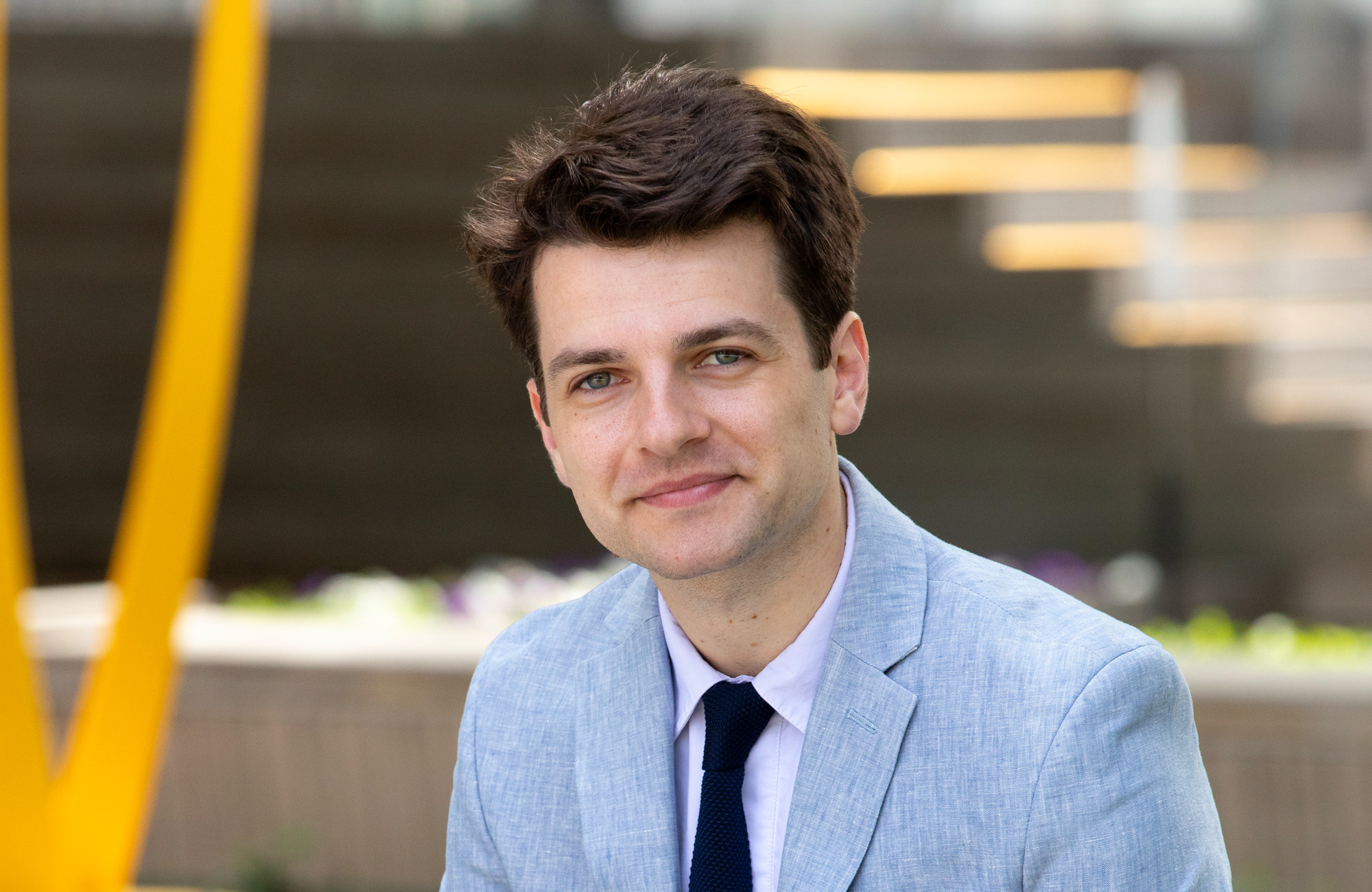
A two-time recipient of the Solti Foundation U.S. Career Assistance Award, Maurice Cohn is currently the 11th Music Director of the West Virginia Symphony Orchestra and serves as Artistic Partner and Conductor of Camerata Notturna. Alongside his work with West Virginia highlights of his 24/25 season include his debuts ...
A two-time recipient of the Solti Foundation U.S. Career Assistance Award, Maurice Cohn is currently the 11th Music Director of the West Virginia Symphony Orchestra and serves as Artistic Partner and Conductor of Camerata Notturna. Alongside his work with West Virginia highlights of his 24/25 season include his debuts with the Filharmonie Bohslava Martinů for Stravinsky’s The Firebird and Tchaikovsky’s Rococo Variations and Omaha Symphony for Kurt Weill’s Symphony No. 2.
Highlights of his 23/24 season included a successful jump-in with the Cincinnati Symphony Orchestra, a return to Aspen Music Festival to conduct the Chamber Symphony in a programme that includes the world premiere of Peng-Peng Gong’s Late Bells for Concertante Piano and Orchestra as well as conducting Mason Bates Philharmonia Fantastique and a concert performance of Terence Blanchard’s Fire Shut Up in My Bones with the Dallas Symphony Orchestra. Recent seasons include debuts with Utah Symphony, Colorado Music Festival, Symphoria New York as well as frequent appearances with the Chicago-Based contemporary ensemble Zafa Collective and the Aspen Contemporary Ensemble. Maurice served as the Assistant Conductor of the Dallas Symphony Orchestra until the end of the 23/24 season, he was also Assistant Conductor of the Aspen Music Festival in 2022 and 2023.
He received the Robert J. Harth Conducting Prize and the Aspen Conducting Prize, and an M.M. in conducting from the Eastman School of Music, where he worked frequently with the Eastman orchestras and OSSIA New Music Ensemble. He holds a B.M. in cello performance from Oberlin Conservatory and a B.A. from Oberlin College, where he studied history and mathematics.
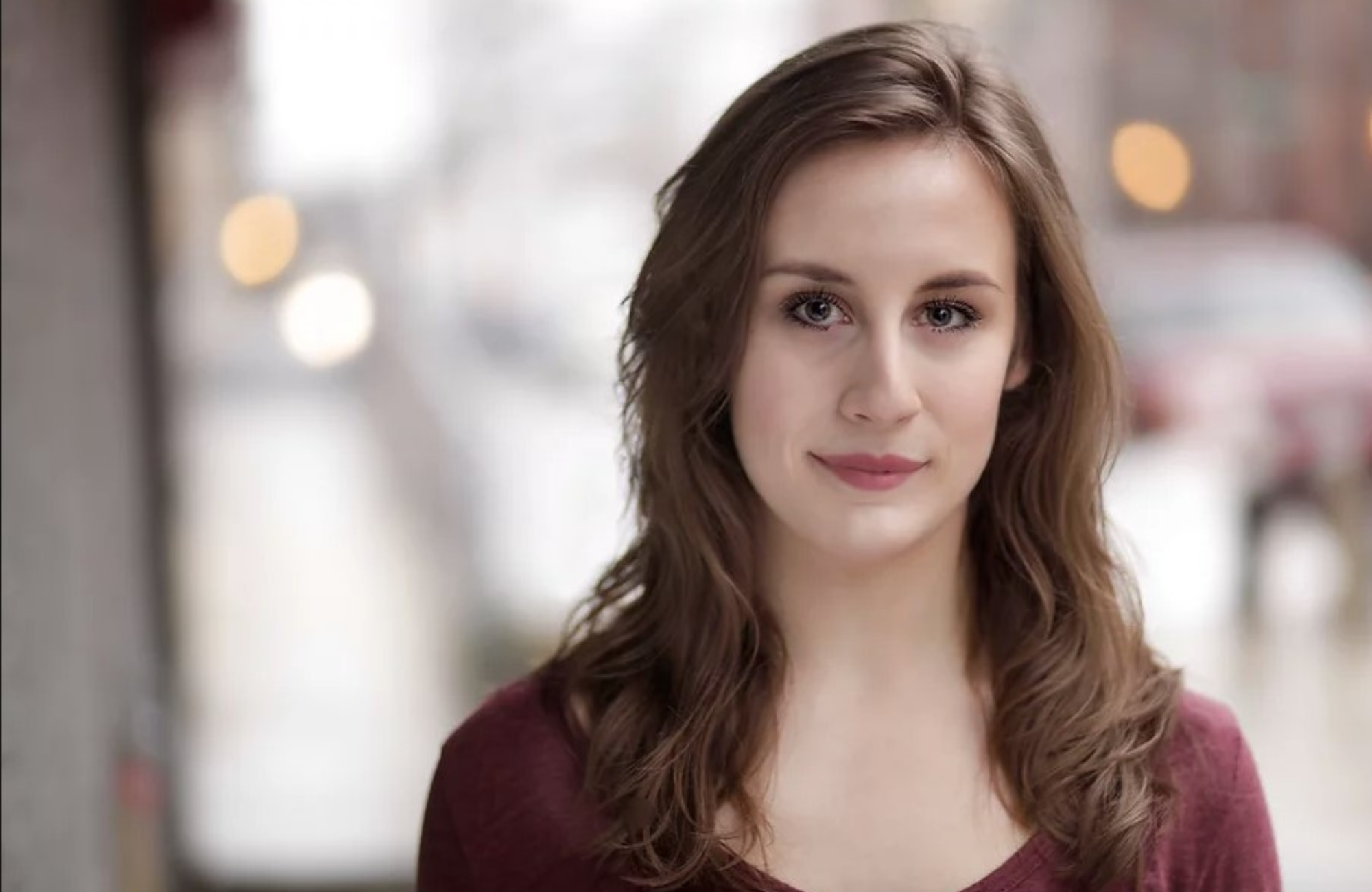
Mezzo Soprano Kay Weber (fondly known as Katie) has been described as a dynamic and moving performer, with a commitment to text, musicality, and communication through music. “Weber possesses a formidable instrument, with a highly melodious but penetrating timbre.”
Kay made her Off-Broadway Debut in Sweetee A ...
Mezzo Soprano Kay Weber (fondly known as Katie) has been described as a dynamic and moving performer, with a commitment to text, musicality, and communication through music. “Weber possesses a formidable instrument, with a highly melodious but penetrating timbre.”
Kay made her Off-Broadway Debut in Sweetee A New Musical directed by Emmy Award Winner Pat Birch at the Signature Theater at Pershing Square Theater Complex. Other Off-Off Broadway productions include Icons/Idols at Opera America and the New Ohio Theater (dir. Colette Roberts), and Henry Box Brown and The Dizzy Gillespie Theater (dir. Mehr Mansuri).
Staged readings include: Kerrigan and Lowdermilk’s Republic, Stephanie Sandberg’s Mezzo, Helen Banner/Grace Oberhofer’s Tetrology Icon’s/Idols, Brad Ross’ Michael Strogoff, Grace Oberhofer’s A Doll’s House: A New Opera at The Tank Theater as Dr. Rank, and a second production of A Doll’s House at Central Square Theater in Boston as Christine Lindt.
She performed as Dorabella in scenes from Cosi fan tutte for a short film directed by Dara Melina in The Plaiedes Product inaugural project.