
You only get one 200th birthday.
Celebrate St. Paul’s Syracuse with The Syracuse Orchestra and the Syracuse University Oratorio Society.
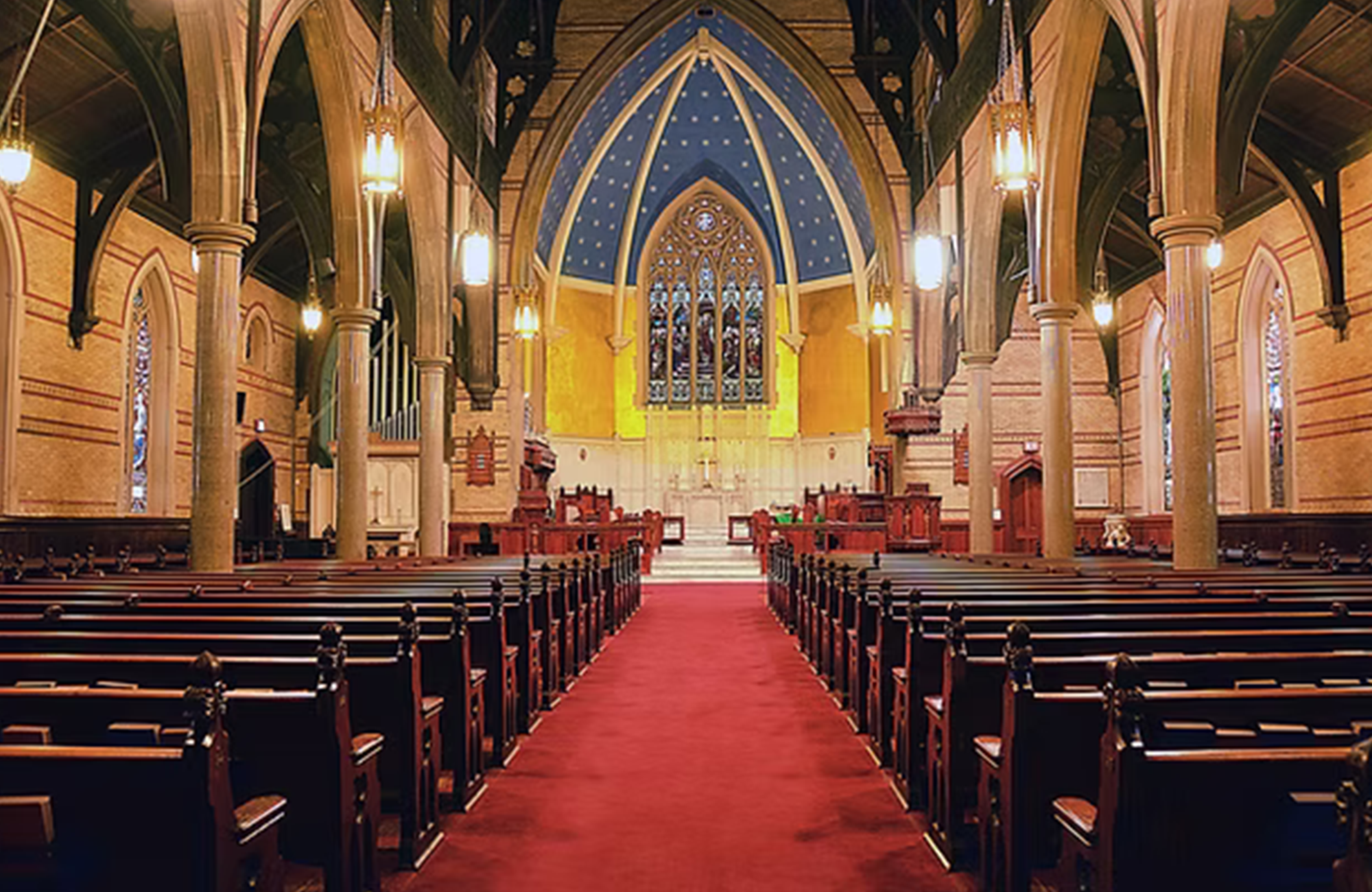
St. Paul’s has been part of downtown Syracuse for 200 years. This fall, it turns 200, and we’re throwing it a birthday party. You’re invited.
Picture a slow Sunday. Lunch downtown. Then you walk into a room full of people who came to celebrate, the orchestra is tuning up, and a choir is taking its place.
When all those voices come in with the orchestra, you feel it before you think about it. You sit up a little straighter. Maybe you reach for the hand next to you. Maybe you just grin.
“The acoustics at St Paul’s Church are amazing!”
– Audience member at Harmonious Winds
The whole afternoon is joyful on purpose. One piece was written as a thank-you. The other was written to feel like a fiesta. Most of the singing is in Latin, and the feeling translates on its own.
Bring your mom. Bring the friend who sings in a choir. Bring the neighbor who’s walked past St. Paul’s a thousand times and never been inside. You’ll be back out by 4:15 with the rest of your Sunday still ahead of you, and you’ll have been part of something that only happens once.
Stay for the reception
When the music ends, stick around. There’s a reception afterward, and it’s a chance to talk with the people you just shared the afternoon with.
“The reception after the concert was a wonderful connection with friends.”
– Audience member
“Being able to connect with people afterwards at the reception. Good idea for a small concert.”
– Audience member
Keep your Sundays full
The Rapid Response Monitoring Casual Series has four more Sunday afternoons at St. Paul’s this season: Voices of Spring in January, Strings of Hope in February, Latin Rhythms in March, and Baroque Splendor in April. Build a FlexPack with the concerts you want, up to 10, and pay subscriber pricing for all of them.
BUILD A FLEXPACK
GOOD TO KNOW
How long is it? About an hour and 15 minutes, no intermission.
What should I wear? There’s no dress code. Sunday afternoon clothes are perfect.
When should I get there? Doors open at 2:00 PM. The concert starts at 3:00.
Where do I park? St. Paul’s has a free lot right next to the building, off E. Fayette Street. Heads up: E. Fayette is closed between Montgomery and S. State while a garage is being demolished, so come in from the west. More parking details here.
Is it accessible? Yes. There’s an accessible entrance straight from the parking lot.
When do I clap? Both pieces have several sections with short pauses in between. Most people hold applause until the whole piece is finished.
PROGRAM
St. Paul’s Suite (Holst): Gustav Holst taught music at a girls’ school in London for almost 30 years. The school built him a soundproof room so he could compose, and one of the first things he wrote in it was this thank-you for the student string orchestra, named after the school: St. Paul’s. In the finale, an old English dance tune starts quietly, then the cellos come in with Greensleeves. The two tunes run side by side, faster and faster, until they finish together. About 12 minutes. 
Magnificat (Rutter), with the Syracuse University Oratorio Society: John Rutter was inspired by the joyful street celebrations held for Mary in Hispanic cultures, with singing, dancing, and processions, and he wanted this to feel like a fiesta. It opens bright and quick. In the quieter middle, a soprano sings a melody and the whole choir sings it back, and one movement is built on a 15th-century English poem that compares Mary to a rose.
THANK YOU TO OUR SERIES SPONSORS!

Casual Series Title Sponsor

Exclusive Automobile Sponsor
PROGRAM NOTES
This afternoon’s concert—actually, festivity is a more accurate word—marks the two-hundredth anniversary of the founding of St. Paul’s Church, an institution as old as the city of Syracuse itself. As Rev. Philip Major puts it, “The church grew up with the city.” Its origins, in fact, predate the city’s charter. “There was a group of people before Syracuse existed who were meeting as a pre-congregation up on Onondaga Hill. But when the Erie Canal was being built and a cluster of residences and businesses gathered where Syracuse is today, they decided they should move ...
This afternoon’s concert—actually, festivity is a more accurate word—marks the two-hundredth anniversary of the founding of St. Paul’s Church, an institution as old as the city of Syracuse itself. As Rev. Philip Major puts it, “The church grew up with the city.” Its origins, in fact, predate the city’s charter. “There was a group of people before Syracuse existed who were meeting as a pre-congregation up on Onondaga Hill. But when the Erie Canal was being built and a cluster of residences and businesses gathered where Syracuse is today, they decided they should move themselves down to where the activity was.” The church had several locations, finally settling where it is today in the late 19th century.
The program doesn’t just honor St. Paul’s—it actually embodies its spirit. St. Paul’s is a civic-minded institution, and it has become increasingly engaged with the local community over its long history. In particular, Rev. Major sees it representing the principle that churches should be “a place where art and culture are embraced and encouraged”—a place committed to “upholding people in their humanity through the arts.” That principle is clearly in evidence this afternoon.
The St. Paul’s Suite by Gustav Holst (1874–1934) is an obvious choice to start the program. It was composed in 1913, just a year before Holst began The Planets—not only his most familiar work, but also one of the most popular works in the orchestral repertoire. But if you’re looking for a Planets prequel, you’ll be surprised. Written for the string orchestra at St. Paul’s Girls’ School where Holst taught for decades, it avoids the scale, the complexity, and the length of The Planets; and largely because of its dance-like qualities and its roots in British folk music (both its general spirit and its incorporation of specific songs), it’s as earthy as The Planets is extra-terrestrial.
And yet there are connections as well. If you have an aural image in your mind when you think of The Planets, there’s a good chance that you’re thinking of the brutal rhythmic pattern incessantly repeated in the first movement (“Mars”). Although there’s nothing brutal in the genial St. Paul’s Suite, you’ll find similar kinds of repeated patterns—called ostinatos—throughout. The technique shows up most obviously in the second movement (appropriately called “Ostinato”), where the second violins repeat the same figure over and over, with imaginative metrical displacements—only stopping for eight bars when the first violins try, unsuccessfully, to wrest it from them.
Obsession marks the last movement, too, adapted from the finale of Holst’s Second Suite for Band. This movement is based on a 16th-century folk tune “The Dargason”—what’s known as a circular tune, since it doesn’t really end, leading back instead to its beginning. With elaborations and musical commentary, it underpins the entire movement. But about a minute into the movement, almost out of nowhere, “Greensleeves”—in a different meter—emerges in the cellos, and we end up with a delightful contrapuntal clash as the two songs are superimposed.
Holst, as I said, wrote the St. Paul’s Suite for strings—but he added some wind parts later on, and it’s this rarely performed expanded version that we’ll be hearing today.
The major work on today’s concert, the 1990 Magnificat by John Rutter (b. 1945), is just as appropriate for today’s celebration as Holst’s St. Paul’s Suite. That’s partly because, as Rev. Major puts it, “part of the culture of the congregation is English church music, and John Rutter is the standard bearer of this tradition.” One of the most widely performed living classical composers, Rutter has produced an extensive catalog focused largely on choral music—primarily liturgical, both small-scale works (including dozens of anthems and carols) and more extensive settings of church texts, including a Gloria and a Requiem. Surprisingly, given his liturgical output, Rutter is an agnostic. But he holds deep spiritual beliefs, and has written that “classic sacred music, our legacy of centuries, has a new importance in our secular age … [as] a meeting place where believers and non-believers can share something unique and spiritual—and agree.” That helps explain why the reach of his music is so great—and why it is especially appropriate to St. Paul’s, with its openness to the faithful, the doubters, the skeptics, and the believers, as well as its commitment to the arts.
The text of the Magnificat, from the Gospel of Luke, has been taken up hundreds of times from at least the Middle Ages to the present, by composers as varied as Palestrina, Bach (Rutter’s inspiration, although not his model), Mozart, Liszt, Rachmaninoff, and Villa-Lobos. In his setting, Rutter interleaves the traditional words with three further texts: the poem “Of a Rose, a lovely Rose” serves as the second movement; the Sanctus from the Mass appears in the third movement; and the Marian antiphon, “Sancta Maria” (Holy Mary) shows up in the final movement, which also returns us to the music of the opening. Since the text is the canticle of the Virgin Mary, Rutter tried to mirror the spirit of those Catholic countries where the Virgin Mary is most “celebrated and revered and enjoyed as a character”—especially Spain, Mexico, and Puerto Rico, which he calls “the sunshine countries.”
The Magnificat thus incorporates two Latin traditions: the sacred Latin tradition of the text, and the Latin American spirit, along with Spanish idioms, that infuses the music (he wanted to create a sense of “fiesta”). You might hear a kinship with the music of Leonard Bernstein, especially West Side Story, which also borrows from Latin American musical traditions. Like the Holst, by the way, Rutter’s Magnificat exists in two versions: one with full orchestra, one with a smaller ensemble. The second seems more appropriate to St. Paul’s, so that’s the one we are presenting today.
If you’re at all anxious about confronting a half hour of contemporary (or almost contemporary) music, there’s no reason for fear. True, some late-20th-century music has the reputation of being challenging because of its difficulty and complexity: its harsh harmonies and lack of immediate melodic appeal. Rutter, however, has been beloved (and occasionally denounced) for his consonance and for what today’s mezzo-soprano soloist Katie Weber calls his “beautifully tonal” style. His richly melodic accessibility makes his music especially suitable for performance by amateurs—and in fact, says Rev. Major, “during this entire season (Autumn)” at St. Paul’s, “the congregation, strongly led by the choir, is singing a gorgeous piece of music by Rutter each Sunday at the beginning of our services.”
Significantly, one of Rutter’s inspirations for the Magnificat was his experience conducting large choirs of amateurs from around the country who gathered to sing in Carnegie Hall. It was his first large-scale work after his Requiem, and he wanted to write something very different. And the elation radiated by those singers when they had a chance to perform in Carnegie Hall spurred him to compose something “really really joyful.” The result is one of the sunniest, most exultant pieces in the repertoire.
Indeed, the sunshine is so blinding, so omnipresent, that it’s easy to think that the work is entirely without clouds. But that’s not quite the case, and from the moment he first started studying the piece, today’s conductor Etienne Abelin “cherished” those moments that go against the grain, the “hints of minor” or the moments with a “little pain.” In today’s performance, he’ll do his best to bring them out—not by exaggerating them, but by shaping the “inner dramaturgical journey” so that you “arrive organically at a point that is more contemplative, or where there might be pain—arrive there quietly and in a way that really makes sense.”
Katie, who has been singing Rutter in church gigs for her entire life, has a very personal view of this music as well, drawn from her experience listening to different performances with different perspectives. “The recording of the premiere features a very big, operatic voice, and I love it because I’m an opera singer. But then I heard other versions, which are typical of the British tradition; the soloist is more like someone pulled from the choir. I think both approaches are beautiful. The original version with the operatic singer really brings out the drama of the piece. But there’s a sweetness to the choral-soloist version that I try to incorporate a little, because it honors Rutter’s vision, too.” She reminds us that many “Anglican choirs in Britain still use boy sopranos”—and she thinks that “that sound is really in his head. There are a couple of points, especially toward the end, where I have a melismatic line and I’m praying to Sancta Maria. It feels like it shouldn’t be this big, dramatic thing—it feels very boy-soprano.” What we’ll hear today, then, will be an amalgam of these two approaches.
So what holds these two works together? Two things in particular. First, there’s their eclecticism. “In Holst,” says Etienne, “you have folk dances”—in particular, in the fourth movement, the two folk tunes “that are woven together. And Rutter does similar things. He takes Gregorian chant elements, he takes a poem from the 15th century, he takes the Latin texts, and he is very much influenced by Latin American and Spanish celebration.”
More important, though, is the sense of community that they produce. As Etienne says, “Both of these pieces are, in a way, about community. They’re celebratory, mostly uplifting and they’re about bringing people together. Hopefully, that’s what’s going to happen in the room when we perform them today.”
Peter J. Rabinowitz
Have any comments or questions? Please write to me at prabinowitz@SyracuseOrchestra.org
P.S. Part of St. Paul’s mission is to provide food for the hungry in the neighborhood. If you are moved to contribute non-perishable food—canned soup is especially welcome at this time of year—you can drop it off in the lobby before the concert.
FEATURED ARTISTS
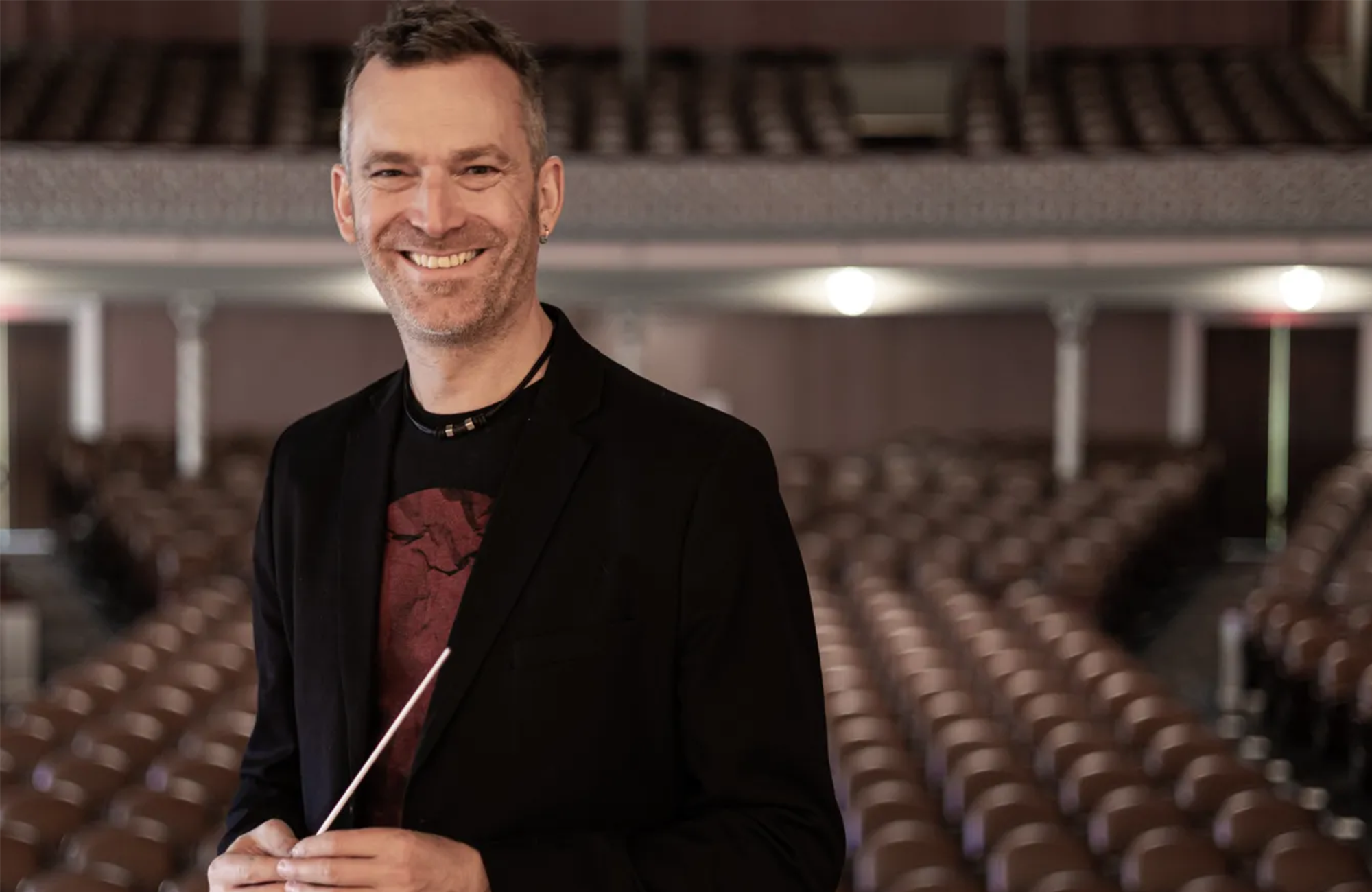
Etienne Abelin is a Swiss conductor and musician celebrated for his innovative approach to classical music, which blends traditional artistry with a modern, genre-crossing sensibility. Described as a “post-classical pioneer” by BBC Music Magazine and an “icon of new ways in classical music” by Musica Viva Magazine Brazil, Abelin ...
Etienne Abelin is a Swiss conductor and musician celebrated for his innovative approach to classical music, which blends traditional artistry with a modern, genre-crossing sensibility. Described as a “post-classical pioneer” by BBC Music Magazine and an “icon of new ways in classical music” by Musica Viva Magazine Brazil, Abelin is known for emotionally charged and unforgettable performances, a sentiment echoed by his mentor, the renowned conductor Jorma Panula.
Abelin’s 18-year collaboration with the legendary Claudio Abbado is one of the defining aspects of his career. Abbado, regarded as one of the greatest conductors of all time, personally selected Abelin to be a founding member of both the Lucerne Festival Orchestra and the Orchestra Mozart Bologna, where he served as Principal Second Violin for seven years. With these prestigious ensembles, Abelin performed in iconic concert halls worldwide and contributed to acclaimed recordings with Deutsche Grammophon and Harmonia Mundi.
As a conductor, Abelin has worked with leading orchestras across Europe, including the Beethoven Orchester Bonn, Musikkollegium Winterthur, Ensemble Orchestral de Paris, and Orquestra Sinfónica Portuguesa. His performances have graced venues such as the Royal Festival Hall London, Teatro alla Scala Milano, Birmingham Symphony Hall, Teatro Sao Carlos Lisbon, and the Odeon of Herodes Atticus in Athens. Abelin is also a passionate advocate for contemporary music and has conducted world premieres by Gabriel Prokofiev and William Brittelle, as well as Swiss premieres by composers like Nico Muhly and Sarah Kirkland Snider. His commitment to expanding classical music’s boundaries is evident in his co-founding of the Ynight-Classical Music in Clubs Series and the Apples & Olives Indie Classical Festival.
In addition to his conducting career, Abelin is a gifted communicator and educator. He has spoken as a TEDx speaker and hosted concerts for orchestras like the Orquestra Sinfónica Portuguesa and the Sistema Europe Youth Orchestra. His work has extended to Swiss National Radio and Television, where he shares insights on everything from genre-crossing music to the art of conducting.
Abelin’s entrepreneurial spirit shines through in his leadership of several projects dedicated to using music for social change and education, such as co-founding the Sistema Europe Youth Orchestra, Superar Suisse, and Music:Eyes – See What You Hear, a music-tech platform focused on music animation. His educational approach includes the 7 Dimensions of Musical Excellence framework, which he developed for the Sistema Europe Youth Orchestra. He is also a member of chamber music ensembles like BachSpace and Nik Bärtsch’s Mobile Extended. His recordings with these groups, released on the Neue Meister and ECM labels, highlight his commitment to innovative classical music.
Abelin is a regular contributor to the Karajan Foundation’s documentary series, Conducting the Future, where he was featured alongside prominent conductors like Marin Alsop and Paavo Järvi.
Born in Bern, Switzerland, Abelin studied violin at the Musik-Akademie Basel, Oberlin College, and Indiana University, while pursuing business studies at the University of St. Gallen. His conducting education includes training under luminaries like Jorma Panula, Neil Varon, and Larry Rachleff at institutions such as ZhdK Zurich, University of Delaware, and Eastman School of Music.
Currently residing in the Capital Region of New York, Abelin enjoys pursuing his passion for coffee and gelato, especially light Ethiopian single-origin brews and Stefino Gelato from Bologna, Italy.